AI HOSPITALITY ALLIANCE · WORKGROUP 3 · IMPLEMENTATION GUIDE
Scalable AI Platform Architecture Blueprint for Hospitality
How to build an AI platform that still works at property 500, across portfolios where the systems
differ, the credentials belong to somebody else, and every conversation costs money.
Includes free, reusable tools for each repeatable part of the workflow.
Central/corporate teams define capabilities, policy and roles
Properties declare what they run and what fills each role
Overview
Get the boundaries right before you build anything on top of them.
Hospitality groups do not run one stack. They run a different stack at every property, and the
question that decides whether an AI platform survives is not which model it uses. It is whether a capability that
works at one property still works at property five hundred without being rebuilt.
Three things decide whether any of this works. Who is allowed to say yes, because in most portfolios
the party operating a property is not the party holding the credential to its systems. Where each capability
belongs, because scoping one wrongly means paying either for central infrastructure nobody needed or for the
same capability rebuilt five hundred times. And what has to be true before a platform can be trusted with a
write, because a model that can change a reservation directly is a model that will.
It is written for owners, operators and brand teams as much as for architects. Nothing in the main sequence names a
product or a protocol. Where a point has a technical consequence, it is stated and then set aside.
The test this guide is built around
A working demonstration is not a platform. The question is whether it still works at property 500,
where the stacks differ, the credentials belong to someone else, and every conversation costs money.
Scalable is given a testable meaning here rather than a rhetorical one: the seven gates in step 09, four
of them specific to AI. A platform meets that test when it can produce a current figure for each of them
across the estate rather than for one installation. That is the definition this guide is organized around, and
whether it is the right one is the fifth choice under what this guide does not decide. It is also why the cost step
ends in figures rather than a claim.
The systems and use cases shown here are illustrative, not a comprehensive catalogue. They demonstrate how to apply the architecture to a few real operating situations. Add the workflows and system combinations relevant to your own portfolio; neither these examples nor the checklist cover every hospitality application.
Three authority models
One architecture, three answers to who holds the grant.
Three kinds of operator are in scope. A management company running a mixed portfolio of several brands. A
mid-market brand whose properties are uniform. A franchisor that dictates the stack its franchisees run.
These need one architecture read through three authority models, not three architectures. The
same layers, the same interfaces, and different answers to a single question: who is allowed to say yes.
Mixed portfolio
Several brands under one operator. Authority is split by flag, and
the operator cannot assume the portfolio is one pool.
Uniform brand
One brand, consistent properties. Authority is concentrated, which
makes most decisions easier and a few of them invisible.
Franchisor
The stack is dictated, but the franchisee owns the business. Authority is
shared over the same guest.
What separates them is not technology. It is who holds the contract with each system, who can grant and
revoke access, who holds the guest relationship, and who pays. Those four boundaries get different answers
in each segment. The architecture states the answers per segment rather than forking into three designs.
Why this matters for everything that follows
Every step in this guide asks you to decide something once and hold it across the estate. Choose your authority model first. Otherwise, you will choose it accidentally, one capability at a time, and the answers will not agree with each other.
01
Decide who is allowed to say yes
Authority is not the same in every portfolio, so decide it before you build.
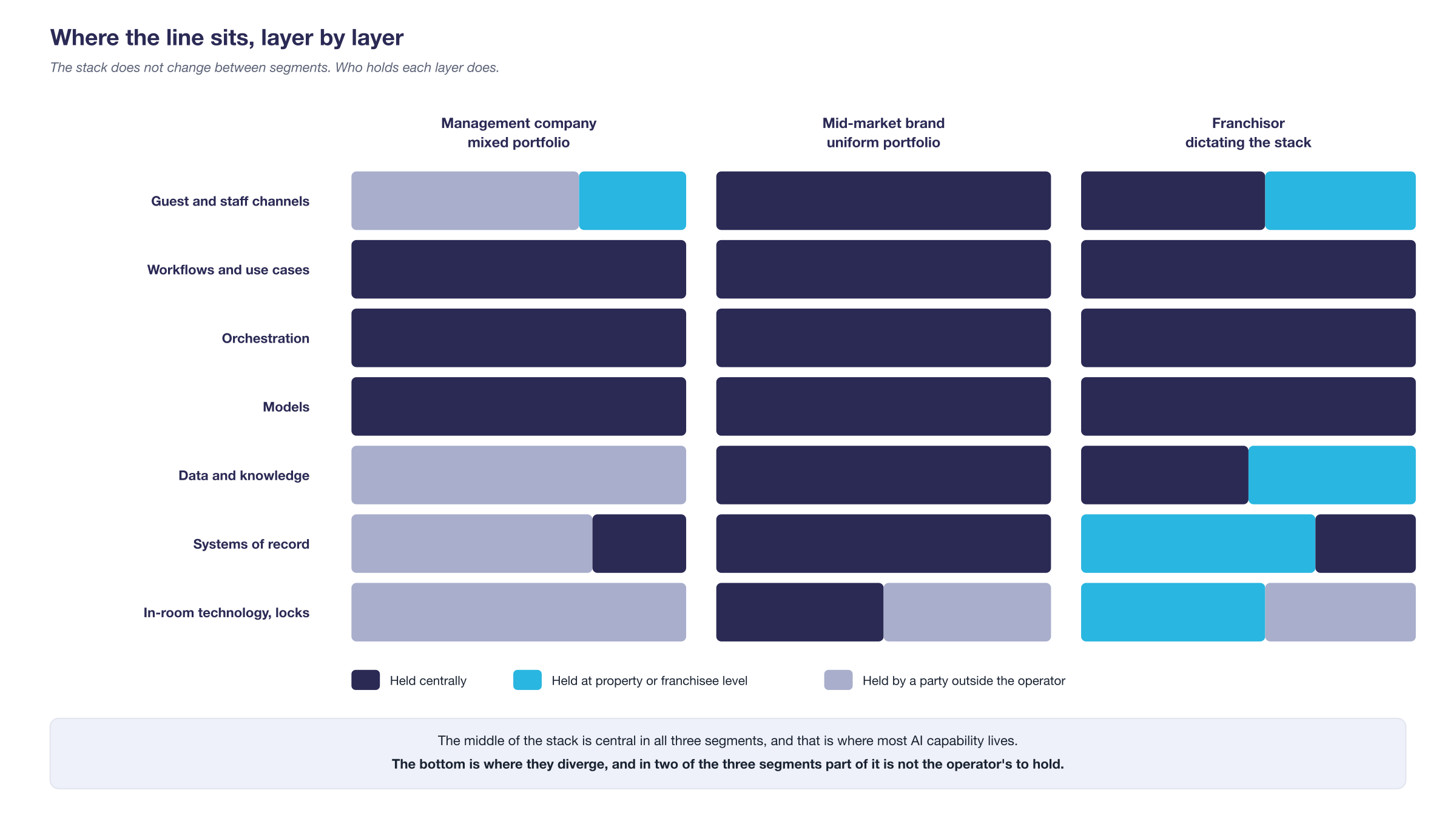
The same finding as the table below, compressed. The middle of
the stack is central in all three segments. The bottom is where they diverge, and in two of the three part of it is not
yours to hold.
The matrix below states fourteen boundaries per segment. Each cell says where the boundary sits, not how the
capability is built. Challenge the reasoned cells first, since those are derived from how the
operating models work rather than observed directly.
Decision
Management company, mixed portfolio
Mid-market brand, uniform portfolio
Franchisor dictating the stack
Basis
Tenancy grain, what counts as one tenant
The flag or the owner entity inside the portfolio. The operator is a parent, not a tenant.
The brand. Properties are scopes beneath a single tenant.
The franchisee legal entity. The franchisor is a policy authority, not a tenant owner.
Reasoned
Credential grant path, who can authorize access to the system of record
Frequently the brand rather than the operator, and it varies per management agreement.
The brand, centrally. One grant path.
Usually the franchisee, even where the franchisor mandates the product.
Portfolio
Data ownership, who holds the guest relationship
Each flag's guest data sits under that brand's agreement, so the operator cannot treat the portfolio as one pool.
One holder across the estate. Separating properties is a permission question.
The franchisee holds it. Franchisor access to aggregated data needs a stated basis.
Reasoned
Model selection and routing
Central, constrained by each brand's processing and residency terms.
Central, with regional variation where compliance requires it.
Central standard, but the franchisee's right to decline or substitute has to be written down.
Reasoned
Autonomy level, what an agent may do without a person
A floor per flag, since brand standards differ. A property may tighten it, never loosen it.
Central and uniform across the estate.
The franchisor sets the floor. The franchisee may tighten it and staffs the consequences.
Reasoned
Evaluation and quality thresholds
Central method, thresholds per flag, because guest expectations differ by brand.
Central, one bar for the estate.
Central method. The franchisee sees its own results, the franchisor sees conformance.
Reasoned
Agent voice, tone and languages
Brand-owned per flag. One agent voice across flags is not available to the operator.
Central, with local language coverage per property.
Franchisor sets the voice, the franchisee adds local specifics.
Reasoned
Workflows, prompts, guards
Central per flag. Maintained once per brand, never once per property.
Central. Property variation by parameter only.
Central template with a declared franchisee-editable band. Uncontrolled local editing is the failure mode.
Reasoned
Property and unit facts
Property.
Property.
Property, the franchisee site.
Portfolio
Human oversight and escalation
Policy central. Routing and queues local, and escalation targets differ by flag standard.
Policy and routing central. Queues local.
The franchisor sets a floor. It does not staff the desk and cannot assume response times.
Reasoned
Observability and audit access
Two audiences. The operator needs a cross-flag view, and each brand may require its own export.
One central view. A property sees its own slice.
The franchisee owns its audit record. The franchisor sees conformance evidence, not raw guest conversation.
Reasoned
Cost allocation
Recharged to owner entities, so cost has to be attributable per property or it cannot be billed at all.
Central budget. Cost per property is an internal efficiency measure.
A fee the franchisee can refuse. Cost per property is a commercial gate, not an optimization.
Portfolio
Change control and rollout
Central release with per-flag approval. The slowest brand governs the schedule.
Central and phased.
Adoption is contractual or voluntary. Rollout is a program, not a deployment.
Portfolio
Offboarding and exit
Properties change operator regularly, so offboarding is routine and needs a designed path.
Rare, and reasonably handled as an exception.
Deflagging happens, and the franchisee leaves with its data.
Portfolio
Apply the boundaries to the systems you actually run
This illustrative system map gives starting points for checking authority in each segment. It is not a complete system inventory or a universal ownership rule. Product selection, day-to-day administration, contractual ownership and permission to grant access can belong to different parties. Verify each against the actual agreement and record the result in the control boundary matrix.
System area
Management company, mixed portfolio
Mid-market brand, uniform portfolio
Franchisor setting the stack
Property management (PMS)
Often brand-mandated per flag. Operator administration may not include the access grant.
Often a centrally held brand contract.
May be selected from an approved list while the franchisee holds the contract.
Central reservations (CRS)
Often controlled by each brand, outside the operator's direct authority.
Typically a central brand service.
Often operated by the franchisor.
Revenue management (RMS)
May be an operator-wide choice, subject to each flag's data permissions.
Often centrally selected and operated.
May be a franchisee choice within an approved list.
CRM, loyalty and guest profiles
Brand loyalty and local guest relationships may have different controllers. Do not assume cross-flag pooling.
A shared profile may be possible within the brand's permitted purposes and access rules.
Franchisor loyalty and franchisee guest records may be separate. Confirm both authorities.
Booking engine, channel manager and connectivity
Check brand control of branded inventory separately from the operator's unbranded inventory.
Often centrally controlled.
Often franchisor-controlled distribution, with access defined by agreement.
Guest apps and messaging
A brand app may coexist with local messaging. Identify the owner of each channel and thread.
Often shared centrally, with property-specific information and routing.
A franchisor app may coexist with franchisee channels. Assign ownership explicitly.
In-room technology, locks and energy
The asset owner may control these systems separately from the operator or brand.
Authority may sit with the brand or asset owner.
Check the franchisee and asset owner's responsibilities.
Food and beverage / point of sale (POS)
The operator or a third-party outlet operator may hold the system and grant.
Central or property-level responsibility may vary by concept.
Often franchisee-controlled, subject to the outlet arrangement.
Finance, accounting and labour
Often managed across the operator's portfolio, with owner-entity boundaries.
Often centrally operated.
Often franchisee-controlled. Franchisor access needs an explicit basis.
Reputation and digital marketing
Brand websites and operator-managed local presence may have different owners.
Often centrally managed, with local responsibilities defined.
Separate franchisor brand channels from franchisee local presence.
The first three areas draw on portfolio experience; the remaining rows are reasoned starting points to test locally. An asset owner or third-party outlet is another authority to consult, not an additional deployment model imposed by this guide.
The finding that constrains everything after this
A central platform reaches only the systems whose credentials that party holds, and those sets barely
overlap between segments. In two of the three, part of the stack belongs to a party outside the platform's
control. A management company cannot acquire ownership of a brand's system of record by design. So the architecture
has to operate through boundaries it does not control, which is why step 05 exists.
02
Place each capability
Ask whether the value comes from one property or from several, then check the segment permits it.
The previous step settled where authority sits. This one answers a different question, and it has to be asked
about every capability separately: does this belong at a property, centrally, or somewhere in between.
The test is whether the value comes from what happens at one property, or from what happens across
several. That gives three answers.
Property scoped
Works identically whether you have one property or five hundred.
Nothing about it depends on the rest of the portfolio.
Central only
Does not merely improve with a view across properties. Does not function
without one.
Central, presented locally
The logic is shared. What a guest or a member of staff
sees is adapted per property.
The failure mode has a direction
Property scoped is cheaper to build first. So without a forced decision, capabilities drift to property scoped by
omission, including the ones whose value only exists once they are centralized. You then pay either
for central infrastructure you did not need, or for the same capability built again at every property.
Then there is a second step, and it is the one most easily skipped.
Step two, for every capability without exception
Read the relevant row of the control boundary matrix for each segment you operate in, and record the result.
A classification is not finished until you have done this.
The capability test asks whether a capability benefits from scale. The matrix asks whether your segment
permits it. A capability can pass the first and fail the second, and only the second is a constraint.
Illustrative capability placements
These four examples show the scoping test in use. They are not a complete list of use cases, and a system category does not determine the placement of every capability within it.
Example
Starting placement to assess
What changes the answer
Housekeeping and engineering tasks
Property scoped when the task depends on that property's rooms and staff.
A shared procedure can be maintained centrally without merging local tasks or room facts.
Revenue management
A shared central method, with the actual forecasting or optimization capability assessed separately.
A mixed-portfolio operator may not pool booking history across flags. Central placement is not permission to pool data, nor proof that every revenue use case needs cross-property data.
Guest messaging and guest apps
Shared logic with local presentation and routing.
In a mixed portfolio, voice, tone and languages may be brand-controlled rather than property-tuned. That changes the boundary and its owner.
CRM and loyalty
Depends on the segment, contracts and authority for the guest relationship.
A single brand may share profiles within its permissions. A mixed portfolio may need separation by flag; franchisor loyalty and franchisee guest records may need distinct treatment. There is no universal placement answer.
Record the result in a checklist that carries three fields per capability, not one: the scope classification with
a one-sentence justification, the role bindings with a declared fallback where a role is unfilled, and the tenancy
and isolation grain.
An assumption, flagged
Treat the placement of loyalty as a recommendation to validate against your operating model. Check who controls the guest relationship, consent and the answer given to the guest before assigning a central or local role. A shared capability does not by itself authorize sharing guest data across brands.
Start a deployment intake
Use the Deployment intake sheet in the Capability checklist workbook ↓ for each capability and release: business purpose → data readiness → model checks → controlled workflow, then release/review. State the outcome and owner first; check the necessary data and model evidence before deciding how the workflow is enabled.
Reference the completed boundary matrix, property bindings and scaling-gate evidence by workbook link, sheet, record and version. Keep the underlying evidence in its existing home instead of entering it again. Revisit this intake during readiness review and after a material change.
For shared instructions and knowledge, also identify the team authorized to maintain them. Maintain one controlled copy at that team or brand level, with permitted local variations. Keep property, unit and reservation facts scoped to the current task. This complements the capability test; it does not authorize pooling guest data or dictate where components physically run.
How to test it
Pick a capability you have already built. Ask which of the three answers it is, then read the matrix row for your
segment. If nobody can say which answer was chosen, it was chosen by whoever built it first.
03
Give every fact one home
One role holds each fact, and every other system reads it.
One role holds each fact. Every other system reads it. These are roles, not products. At each
property the role is filled by whatever that property runs, and there is only ever one of it.
The fact
Where it lives
What every other system does
Availability and inventory
Recommended: property management or central reservations; select one authoritative owner
Reads it. Nobody keeps a second version.
Rate and price
Revenue management
Quotes it. Never sets it.
Reservation state
Property management
Follows it. A change made anywhere else is a change that did not happen.
Guest identity and consent
Recommended: guest relationship management
References it. Consent is not collected again per channel.
Room and unit status
Recommended: housekeeping and maintenance
Reports into it and reads back from it.
Charges and folio
Recommended: property management
Requests a charge. Does not post one.
The guest conversation
Whichever channel currently owns the thread
Waits to be handed it.
The third column is the one that matters
Drift between systems comes less from writing to the wrong place than from a second system keeping its own
copy of a fact and answering from it. An agent makes this worse, because it answers quickly and confidently
from whatever it happens to hold.
The table is a starting point for assigning authority, not a universal allocation. Guest identity and consent, room and unit status, and charges and folio use recommended role assignments. Validate them against how your estate operates. For availability and inventory, choose property management or central reservations as the authoritative owner. In every case, assign authority to the role that controls changes to the fact, not merely the system that displays it, and record the choice.
One more rule that is easy to miss. The guest conversation has one owner at a time, and handovers between channels
are explicit events rather than something that emerges from whichever system replied last.
How to test it
Pick one fact and ask every system that displays it where it got it from. If two systems can answer the
same question from their own stored copy, you have two homes and you will eventually get two answers.
04
Write workflows in roles, not products
A definition that names a product is a property integration, not an estate capability.
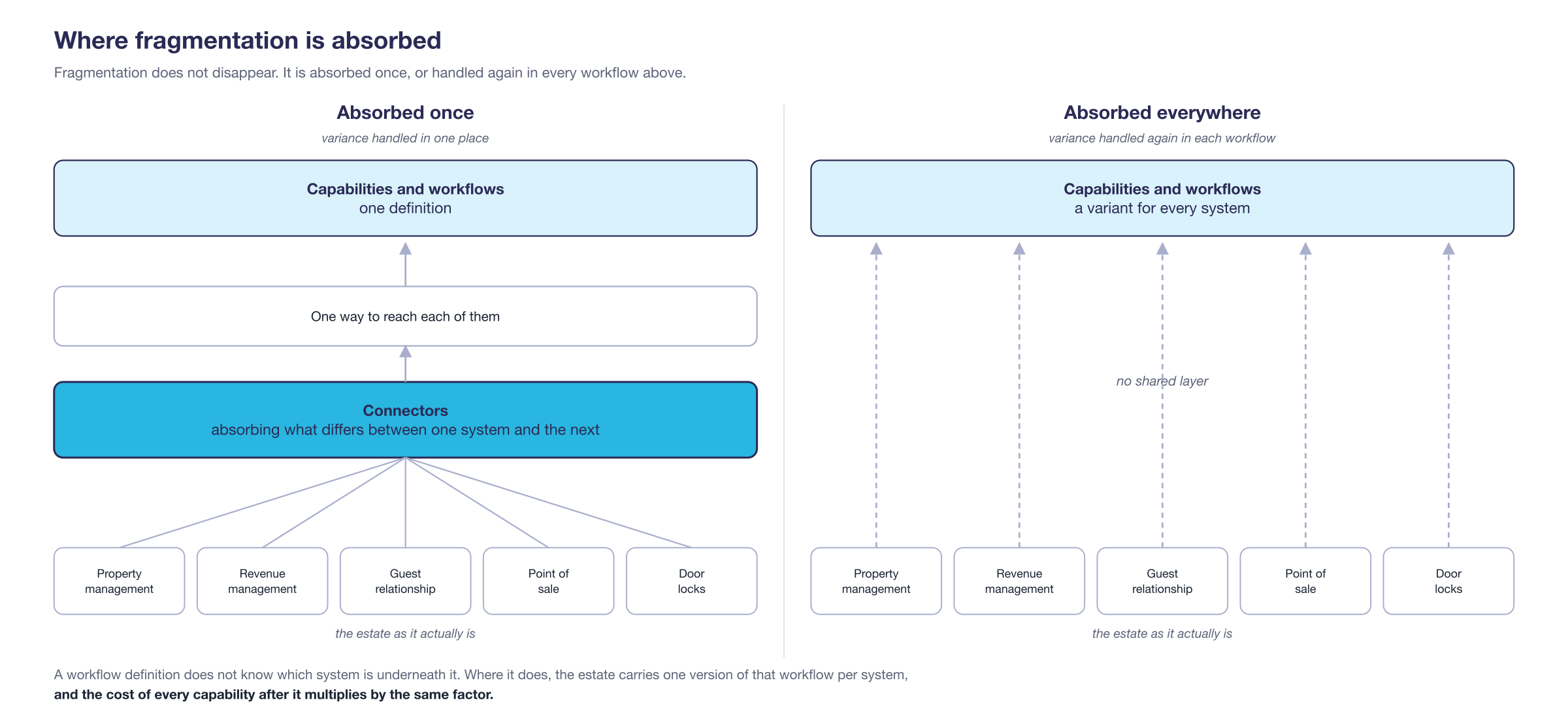
Fragmentation is not removed by architecture. It is relocated. The differences between your
systems get absorbed once, low in the stack, or they get handled again in every workflow you ever write.
The map of hospitality systems carries around thirty categories, and most of them are acquiring their own agent.
Across several hundred properties with stacks that do not match, one question governs everything: can one
definition of a piece of work run everywhere without being rebuilt.
The requirement
Workflows are defined in roles, not products. A definition names a price source, not a named
revenue system. Each property binds those roles to whatever it actually runs.
That gives you a test you can apply to any workflow document you already have.
The test
A workflow definition that names a product is not an estate capability. It is a property
integration, and it will be rewritten for the next stack.
The same five systems, two ways. The left panel
absorbs the differences once. The right panel handles them again in every workflow you ever
write.
Two consequences worth planning for. A property missing a role degrades to a declared fallback rather than
failing, and that fallback is a binding recorded in the bindings table, not a branch of logic buried inside
a workflow. And definitions and bindings are versioned separately, because a change to a definition
reaches every property while a change to a binding touches one.
There is also a constraint on ambition that is better stated early than discovered late. The least capable
integration sets the pace for the whole portfolio. A capability is genuinely estate wide only where every
property's stack supports it. Rollout planning has to assume this rather than hope around it.
How to test it
Search your workflow definitions for vendor names. Every hit is a place the definition will fork the next
time a property changes system.
05
Bind each property
This is the step the estate turns on.
Every step so far produces a definition that is supposed to hold across the estate. This is the step that makes
that possible, and it is the one most often missing.
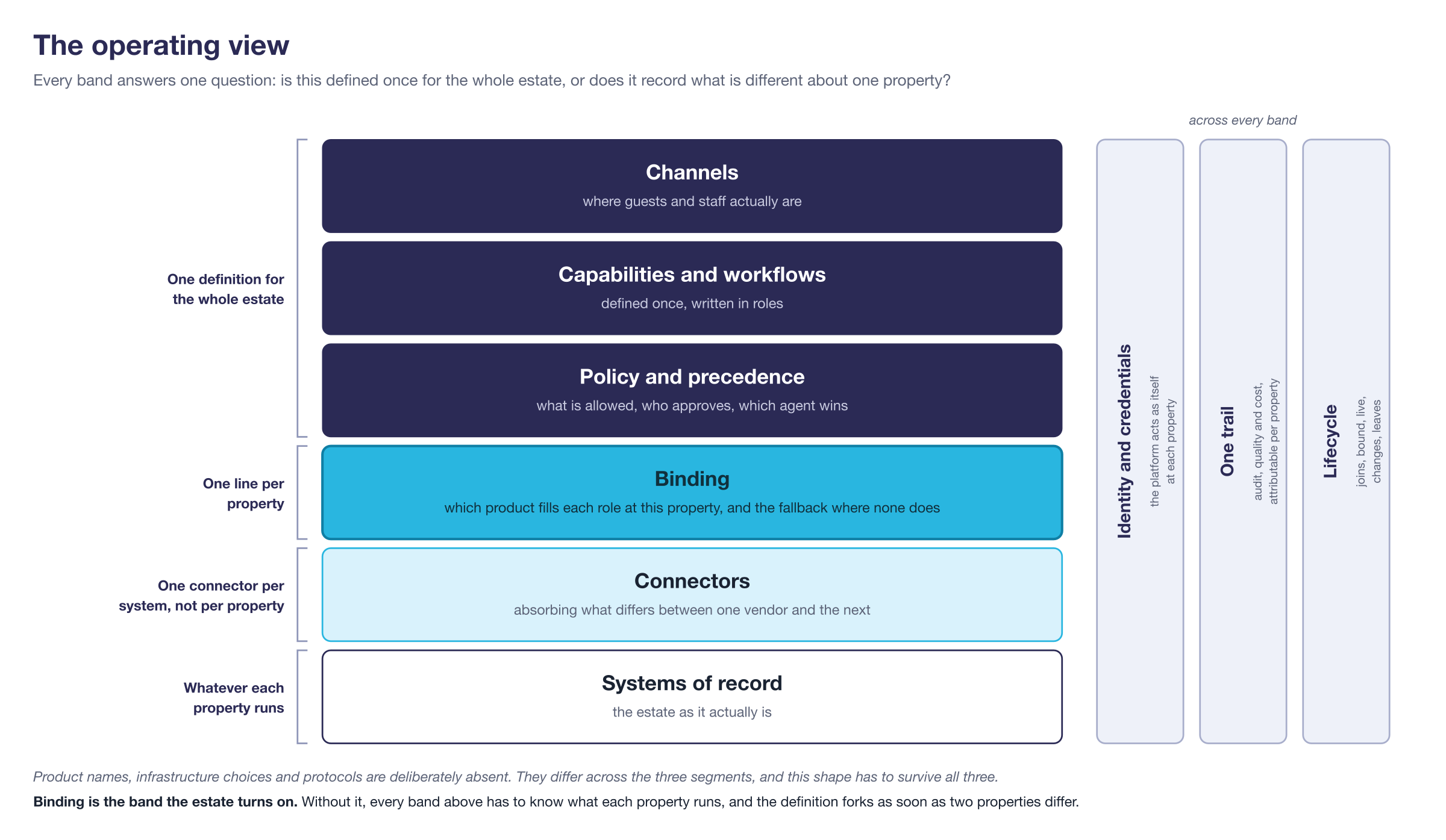
The binding band records which product fills each role at this property, and the fallback where none
does. One line per property. Everything above it is written in roles. Everything below it is whatever the
property actually runs.
Without it
Workflows above have to know what each property runs, so the
definition forks the moment two properties differ. You maintain five hundred configurations.
With it
A property missing a system declares a fallback. A property
migrating changes one line and nothing above it moves. Onboarding becomes a finite task with a definition of
done.
The operating view below shows where the band sits. The six bands each answer one question: is this defined once
for the whole estate, or does it record what is different about one property?
The operating view. Product names, infrastructure choices and
protocols are deliberately absent, because they differ across all three segments.
How to test it
Take one capability and draw it through every band at two properties with different stacks. If anything
above the binding band changed, you have described a system rather than a platform.
Check what the installed systems can support
A connection alone does not establish readiness. In the Capability checklist workbook, use Prerequisite checks to ask the responsible system or agent vendor about the fields, APIs and events needed by the selected workflow. Record applicability, evidence, who verified it, and the reduced service or fallback when something is missing.
The checks cover selected booking and guest-service needs and four agent-vendor obligations; they are illustrative, not an exhaustive procurement checklist. Add checks for other use cases. Single-unit addressability matters only when the selected workflow needs it and does not redefine tenancy. A governed content copy or a separate payment service can be a valid design, not automatically a defect. R23 ↓
06
Keep the model out of the write path
Models may propose. Only deterministic, policy enforced code may act.
Every other step in this guide is about structure. This one is about safety, and it is the most technical step
here. It earns that because it is the boundary an operator is most often asked to take on trust,
and it is the one that should be least negotiable.
The one non-negotiable statement
Models may propose structured actions. Only deterministic, policy enforced executors may authorize and
perform side effects against business systems.
In plainer terms. A model can say what it thinks should happen. Something else, which is ordinary code with
ordinary rules, decides whether it happens and then does it. The model never holds a credential and never
reaches a system of record directly.
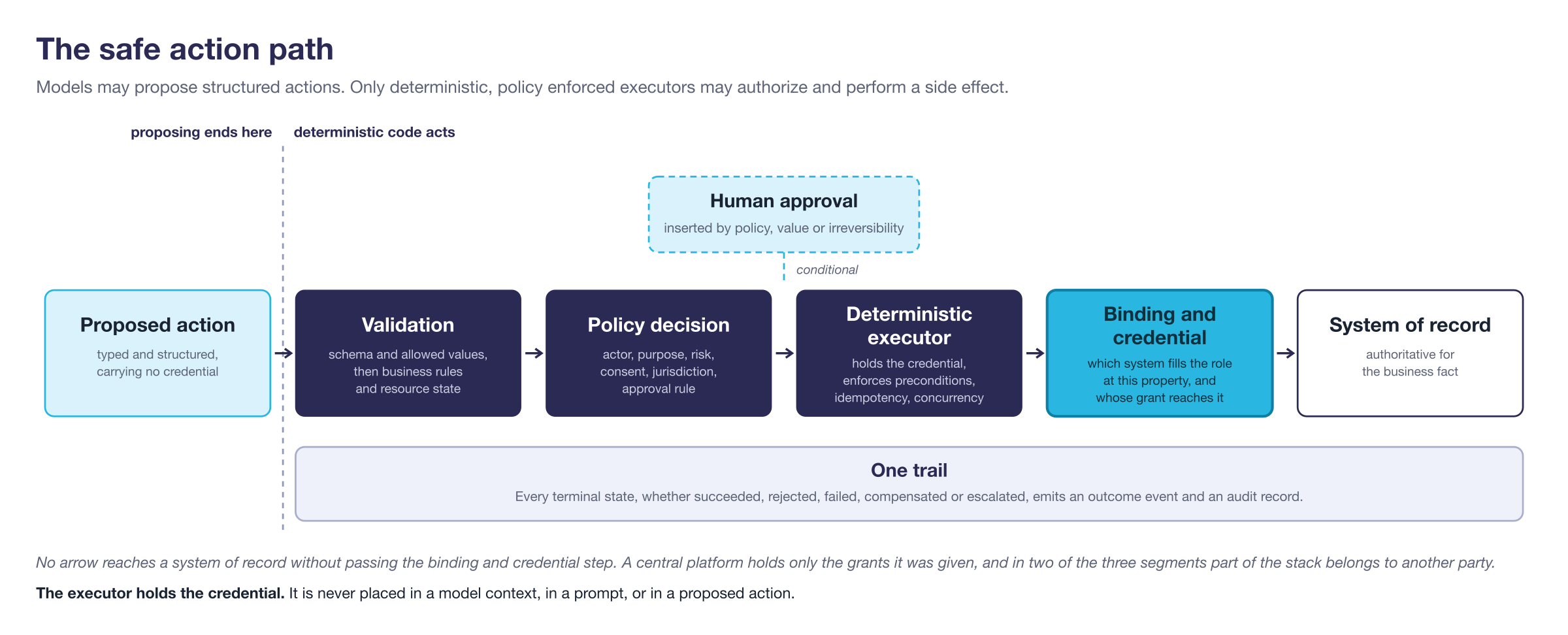
The path below is what sits between a proposal and a booking actually changing.
The safe action path. The figure states the write boundary only, which
is why it can be published while other parts of the operating picture are still being settled.
A typed proposal. The model emits a structured action, never an executable credential and
never an unrestricted tool call.
Two kinds of validation. One checks the shape and the allowed values. The other checks
business rules and whether the resource is actually in a state where this makes sense.
The policy decision. Who is asking, for what purpose, at what risk, with what consent, under
which approval rules, in which jurisdiction.
Human approval, where policy requires it. Triggered by policy, by low confidence, by
transaction value or by anything irreversible.
The deterministic executor. This is what holds the credentials. It also handles preconditions,
making sure the same action does not happen twice, and what to do when two things collide.
Evidence. The response and the resulting events become the record used for audit, evaluation,
notification and putting things right. Reading leaves a record too. A read or an event carries the
same request context as a write and emits the same access record, so the question of who reached a guest's data, and
on whose authority, has an answer that does not depend on which component happened to serve it.
Same rules, wherever the system runs
This is a recommendation about behavior, not a requirement about location. Every path that serves data should record who accessed what and under whose authority, using the same fields. Each path should use the same code to judge how current the data is, rather than implement its own version of that decision.
A central copy, a regional copy, a copy at the property, or a single shared path are all acceptable. The operator chooses where it runs; nothing here requires a component at a property. An existing central middleware layer does not need to be redesigned to follow this recommendation. The controlled write path described above stays unchanged.
Approval and escalation are not the same operation
Approval is a checkpoint on an action. Escalation is a transfer of the guest relationship. A
platform has to support both, and they behave differently. On escalation the agent packages a summary and hands
ownership to a role, never to a named individual, because staff rotate and no agent can track who is
on shift. After a transfer the conversation does not automatically come back, and no outcome status can be
assumed to flow back either.
The same path, walked through one real refusal
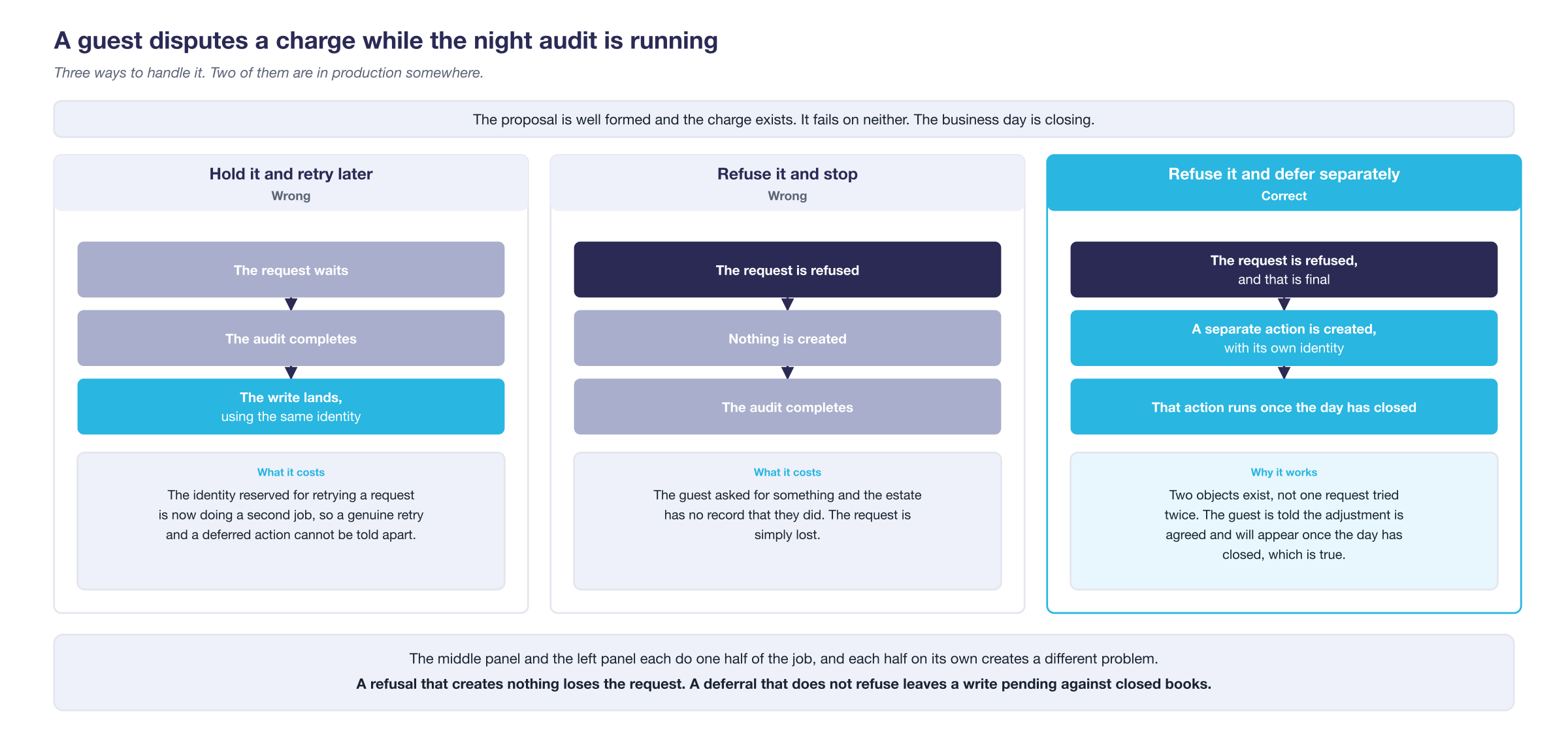
It is two in the morning and the night audit is running. A guest disputes a charge, and the agent proposes removing
it. Follow the six steps and watch where it stops.
The proposal is well formed, so it passes the first check. The charge exists and the folio is open, so it passes the
second. Policy identifies it as a financial write. Then the executor asks the property what state it is in, and the
answer is that the business day is closing.
What happens next is the part most designs get wrong, and there are three ways to handle
it.
A write left pending against books that
have already closed is a discrepancy someone reconciles by hand in the morning.
Keep long-running work reliable
Protect guest-facing response times when a publish, push or sync takes longer. Use durable background work that can resume after interruption, retry without creating duplicate writes, and hold repeatedly failing jobs for investigation. Separate workers and queues are one way to achieve this; their physical location remains the operator's choice.
Carry the tenant identity and permitted property scope through every request, job and tool. The tenant follows the authority model in step 01. Keep the same execution identifier from proposal through validation and the authorized executor to the resulting write, recording the outcome, elapsed time and cost. Test that a failure stays within its intended property or workflow boundary.
How to test it
Three failure tests, all of which happen in real deployments. An escalation that dead ends because the person it
was assigned to is off shift. Any component that waits for a completion signal that no operational system
actually sends. And a financial write attempted during the audit window, to see whether it is refused, queued,
or simply allowed through.
07
Decide which agent wins
A lock decides who was faster. Policy has to decide who is authoritative.
By the time an estate runs more than one agent, and most already do, two of them will eventually want the same
resource at the same moment. That is not a rare collision to be handled when it happens. It is a design
question with an answer, and the answer belongs in policy rather than in whichever component notices first.
The distinction the whole step rests on
A lock decides who was faster. It does not decide who is authoritative. Ordinary concurrency
control will stop two agents corrupting a record. It will not tell you which of them should have won, and it will
happily let the less authoritative one succeed because it arrived a moment earlier.
So precedence is resolved in advance rather than detected afterwards. Where two agents are each
individually permitted to act on the same resource, policy says whose action takes effect before either of them
runs.
That has two practical consequences for the write path in the previous step, and both are small additions rather
than new machinery.
Identity carries the agent, not just the actor. Which agent is acting, which version of it, and
under what authority. Without this you cannot answer the question an operator will eventually be asked, which is
which agent did that.
Safety carries a precedence class. So that two permitted proposals against the same resource
resolve the same way every time, rather than by arrival order.
One thing this guide deliberately does not define: the authoritative list of which agents are permitted, and on whose authority. Treat that as a shared directory the platform consumes rather than a second list it maintains, because two lists means neither is authoritative. The fields this guide expects to consume are identity, owner, purpose, capabilities, versions and scopes.
Build the attribution first, whatever else waits
Per-agent attribution is worth building early on operational grounds alone. Every question that follows a
bad outcome starts with which agent did this, under whose authority, at what version. An estate that cannot
answer that has to answer it by reconstruction, and reconstruction after the fact is a much larger job than recording
it at the time.
How to test it
Name two agents in your estate that are both permitted to act on the same resource, then ask what happens when they
both do. If the answer describes a lock, a retry or a race, you have concurrency control and no precedence
rule. Then ask whether your logs can name which agent performed the last write to any given record.
08
Support the flows that are not generic
The sequences and obligations that are specific to hospitality, and cannot be added later.
Every step so far would read much the same for a bank or a logistics operator. This one would not.
Hospitality operations have shapes that general purpose platforms handle badly, and obligations that cannot be bolted
on at the end. Both have to be in the design from the start, which is why they are a step and not an appendix.
The distinction that matters
The sequences below are normal operations, not edge cases. A platform that treats them as
exceptions will work in a demonstration and fail in a hotel.
Seven sequences that break general purpose designs
Sequence
What actually happens
Why it is harder than it looks
Rate cascade
A pricing decision moves from revenue management through central
reservations out to every distribution channel, and rate parity commitments have to hold at each hop.
One
decision becomes writes to several systems that must all land or all be undone. A partial success is not a
partial success, it is a parity breach.
Guest arrival chain
Check-in sets off room assignment, housekeeping notification,
minibar activation, entertainment personalization and a welcome message.
The steps have an order, each can
fail on its own, and stopping halfway leaves a guest in a room the rest of the estate does not know is
occupied.
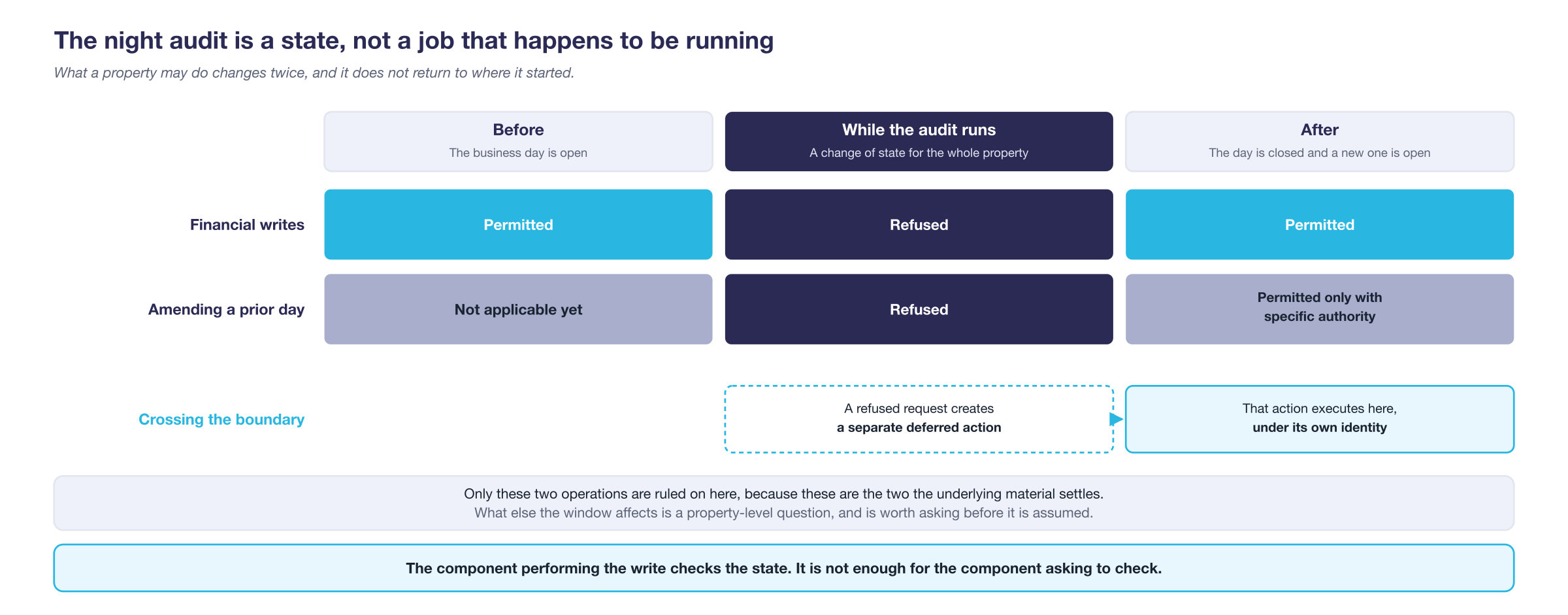
Night audit boundary
A nightly run closes the business day, posts recurring charges,
advances reservations and resets counters.
It is a change of state for the whole property rather than a job
that happens to be running. Some actions have to be refused while it runs.
Group block lifecycle
Held rooms with pickup deadlines, rooming lists, attrition
penalties, and a cutoff date that releases whatever is left back to general sale.
It runs for weeks or months
and each decision carries a contractual consequence, so it cannot be modelled as a request and a
reply.
External booking arrival
Bookings from third-party channels arrive when they arrive,
then become a reservation, a property record, a loyalty accrual and a confirmation.
Nothing is triggered by a
person waiting for an answer, and deliveries repeat, so the same booking must never become two.
Displacement economics
Deliberate overbooking, with a real cost at the moment a guest
has to be relocated or turned away.
An availability answer is not only a number. It carries a risk of walking
someone, and that risk has a price that the answer should carry with it.
Cross-property transfer
A guest moves between properties in the same portfolio, and
profile, preferences, folio and loyalty context need to follow.
The context has to cross exactly the boundary
that the data rules are there to keep closed.
Two of these are not yet fully specified anywhere
Rate cascade and the group block lifecycle both sit on the booking critical path, and neither has an
agreed specification for how systems should exchange them. They are named here because a plan that assumes
they are solved will discover otherwise late. If you are buying, ask how each is handled rather than whether it
is supported.
The third sequence above,
in full. The state after the window is not the state before it, and the deferred action is the one thing that crosses the
boundary.
Eight obligations that cannot be delegated downstream
These are legal, contractual or safety obligations rather than business preferences. The distinction has a practical
consequence: a preference can be checked at the end, an obligation has to be built into the path so it
cannot be bypassed by a component that did not know about it.
Obligation
Where it has to be enforced
Rate parity. Direct rates keep an agreed relationship to third-party rates.
Rate change
proposals are checked against the agreements in force before anything is written to a distribution
channel.
Brand standards. Franchised properties conform to mandated technology standards, data sharing
terms and service levels by tier.
Brand policy applies as an overlay, with credentials scoped so that applying
a standard does not hand over access.
Night audit lock. Financial writes are prohibited while the audit runs, and prior-day changes
afterwards need specific authority.
The component performing the write checks audit state first. It is not
enough for the requester to check.
Payment isolation. No model, prompt or retrieval step may reach raw card data, and no card data comes to rest in a retrieval index, a cache, a conversation log or a prompt store.
A structural boundary, not a rule. Payment components expose only a token and an authorization status, and a payment action crosses as a token rather than as an instrument. Treat that as a claim to be tested rather than a property you have. An index or a cache built before the boundary was in place can still hold card data, and the boundary says nothing about what is already stored.
Guest data jurisdiction. Regional privacy rules, including erasure that has to reach every
system.
Residency enforced where data is accessed, and deletion propagated with evidence that it
happened.
Overbooking exposure. Anything influencing availability has to quantify displacement risk.
Proposals carry a risk score, and past a threshold a person decides rather than the system.
Franchise data control. The franchisee legal entity controls guest data for its properties, and
may be a different organization from whoever runs the property day to day.
Isolation at the franchisee entity,
with property-level scoping beneath it. Where a management company operates a franchised property it acts on
the franchisee's behalf and does not become the controller.
Operating mode. Properties run in modes such as peak, convention or renovation, with different
parameters.
Mode is declared and shifts thresholds, approvals and permissions together, rather than each being
tuned by hand.
Three things in this guide are one chain
Deciding where a capability belongs, deciding who holds each layer for your segment, and the franchise data control
obligation above are the same question at three stages. The first asks where a capability should sit.
The second answers it for your operating model. The third is how the platform holds that answer once it is
made, so that the boundary survives contact with a system that would happily ignore it.
How to test it
Take the two sequences above that have no agreed specification and ask how each is handled end to end. Then pick the
night audit lock and ask which component checks the audit state. If the answer is that the requesting
application checks before it asks, the obligation is a convention rather than a control, and a future component that
does not know the convention will breach it.
Then test payment isolation rather than assuming it. Search the retrieval index, caches, conversation logs and prompt store for data that looks like card details. Treat each match as a potential finding to investigate, not automatic proof of a leak. If no search has been run, record a verification gap: the boundary tells you what is not supposed to arrive and says nothing about what arrived before it was in place. Test the places data comes to rest, not only the steps that touch it.
09
Measure what scale costs
Seven gates, each producing a figure you can put in front of a finance team.
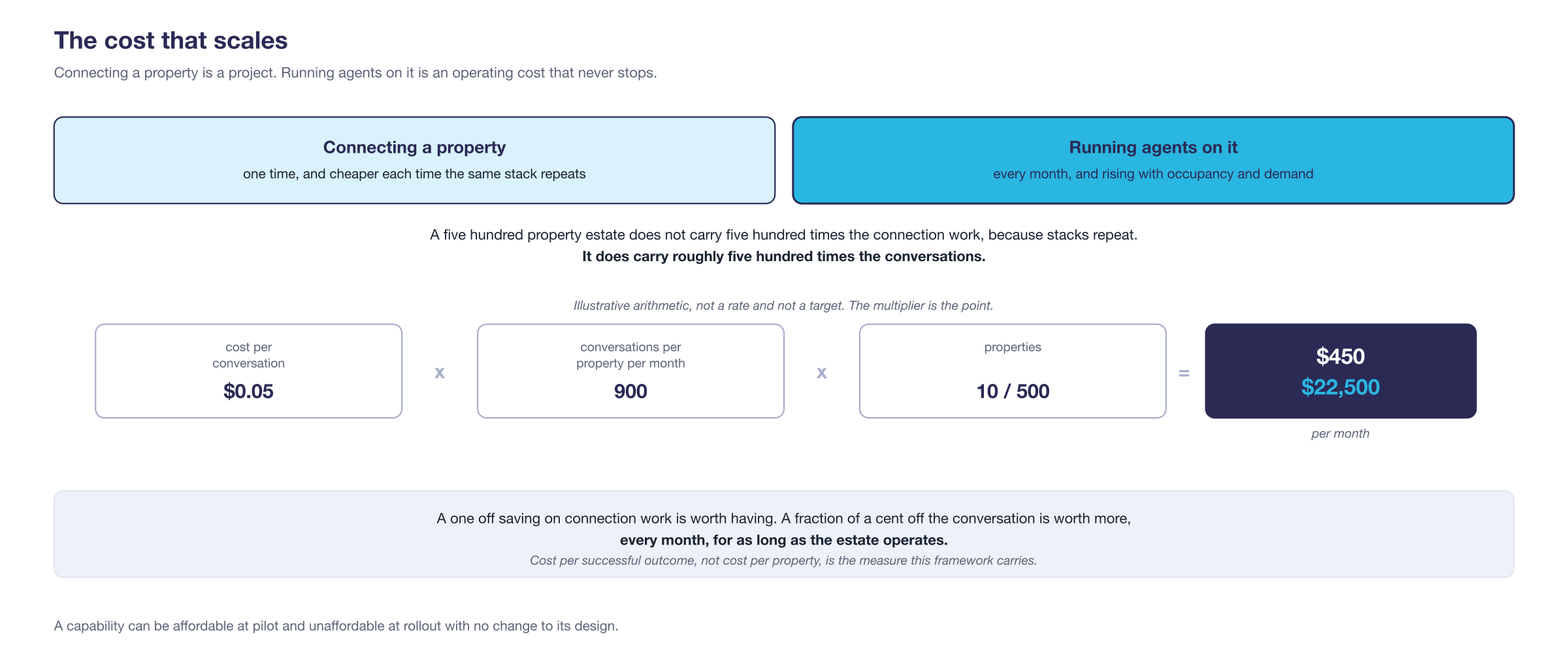
Two things go wrong when operators budget for this. They count properties, and they count the cost of connecting
systems. Neither is the number that scales.
Properties is the wrong unit
The cost of adding a property is set by its
stack, not its size. Two operators with four hundred properties each face different work depending on how
many distinct systems sit underneath. Doubling inside systems you already support barely moves the curve. Doubling
by acquiring properties on four unfamiliar systems moves it a lot.
Connection cost is not the cost that recurs
Connection work is one time and
falls as stacks repeat. Model cost recurs every month and tracks guests, not buildings. A five hundred
property estate does not carry five hundred times the connection work. It does carry roughly five hundred times
the conversations.
The arithmetic is illustrative, not a rate and not a target.
The multiplier is the point.
The consequence to plan for
A capability can be affordable at pilot and unaffordable at rollout with no change to its design.
How much context you assemble per turn, how often you reach for the largest model, and what share of requests you
answer without a model at all are unit economics at estate volume, not engineering detail.
So the measure is cost per successful outcome, not cost per property. And there is a related
requirement that is easy to treat as a reporting nicety when it is actually architectural.
Being able to attribute cost is a design requirement
In a management company, platform cost is recharged to owner entities. In a franchise model it is a fee a
franchisee can decline. An architecture that cannot produce a defensible per-property cost figure cannot be
bought in two of the three segments. Note the bound on the claim: this tells you whether a capability paid
off. It does not make it pay off.
The seven gates
A platform meets this step when it can produce a current figure for each of the gates below. The
first four are specific to AI systems. There are no target numbers here on purpose, and the reason is under
what this guide does not decide.
Gate
Measures
Passes when
Cost per successful outcome
Model and infrastructure cost of one resolved request, booking or answered question.
The figure is known, and falls as volume grows.
Escalation load
Share of interactions reaching a person, and the staff hours that implies across the estate.
Required human capacity is known in advance.
Evaluation coverage
Whether a change in answer quality at one property is detectable.
Quality is measured per property or per segment, continuously.
Model change resilience
Effect of a provider changing or retiring a model beneath a live workflow.
A model swap can be tested against real workflows before it becomes mandatory.
Onboarding effort
Hours to bring one property live within an already-integrated stack profile. First-time adapter work for an unfamiliar stack is measured separately.
Within a known stack profile, the figure at property 500 matches the figure at property 10.
Rollout reach
Time for one capability to reach every property entitled to it.
No per-property action is required for a capability to arrive.
Offboarding effort
Work to remove one property, and what remains afterwards.
Removal is a routine task with a defined end state.
Use reliability evidence behind the figures
Before widening a rollout, test tool contracts and validators, denied access across tenant and property boundaries, simulated integrations, and whether prompts select the intended tools. Then run controlled live evaluations on a small, authorized scope. These checks strengthen evaluation coverage; teams still need representative questions and a method for judging answer quality.
Keep cost per successful outcome as the main measure, with breakdowns by property, workflow, model and vendor. Test whether budget controls can slow or stop one workflow without interrupting the rest. Use the workbook's Reliability checks sheet to record local acceptance criteria, actual evidence, owners and follow-up actions alongside the seven gates.
Connect evaluation to a business outcome
For each workflow, name the business outcome signal and the person responsible for measuring it. If the outcome cannot yet be measured, record why, who will address the gap and when it will be reviewed. A declared measurement gap makes the limitation visible; it does not pass the evaluation gate or count as a successful outcome.
Test model portability with a different model family, not only a version upgrade. Run representative workflows and compare answer quality, tool use, safety, latency and cost. Recheck scope boundaries and controlled writes. API compatibility does not establish equivalent behavior; record the experiment under Reliability check 29.
Keep operational telemetry—errors, latency, execution records and cost—distinct from guest-insight analytics or reporting sold as a product. The latter needs its own stated purpose, owner and access rules. Having reliability logs does not automatically authorize a new use of guest conversations or create a duty to deliver analytics reports.
How to test it
Ask for the seven current figures. Not targets, not projections, the figures as they stand today.
A gate nobody can produce a number for is a gate you are not measuring.
10
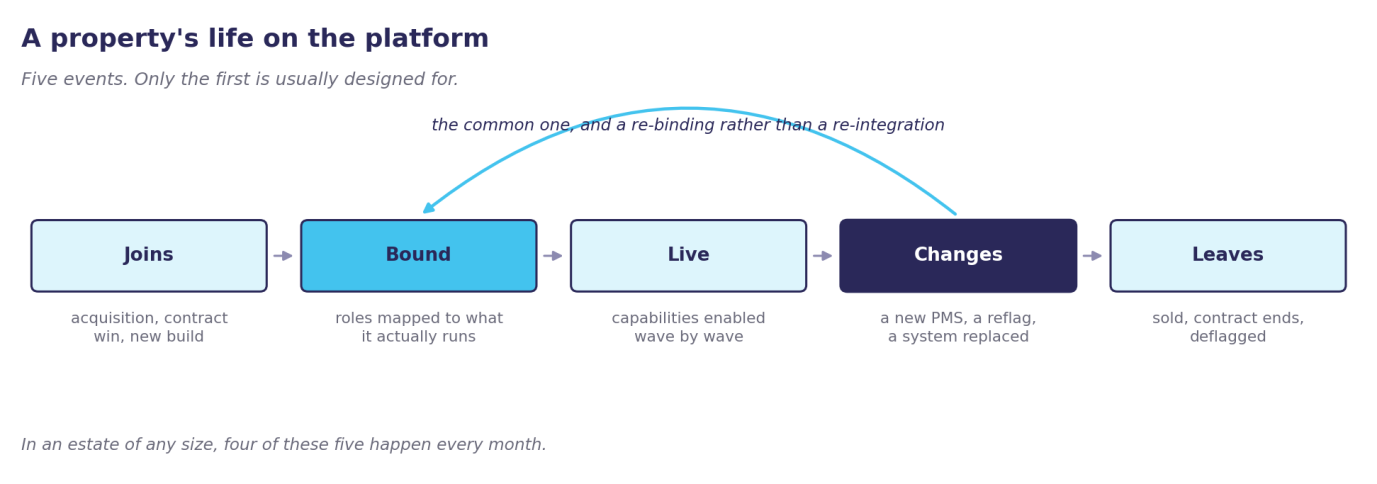
Run the five events in a property's life
Joining is designed. The other four are what actually cost you.
Joining is the only one that happens once. A
change is a re-binding, so it returns to the second event rather than following the third.
Event
What has to happen
Done when
Joins
Its systems are identified and mapped to the roles the workflows use, and the history that comes with it is scoped.
Every role is either bound or has a declared fallback, and what history is imported has been decided rather than assumed.
Bound
Credentials issued, scope set, property facts loaded, historical data imported off the serving path, fallbacks recorded.
The property appears in the estate view, the import has finished, and no manual steps are outstanding.
Live
Capabilities enabled by wave rather than all at once.
Each enabled capability has a named owner at the property.
Changes
The affected bindings are swapped, and the history held in the old system is migrated, kept reachable, or deliberately let go.
Nothing above the binding layer had to be touched, and the agent knows as much about a returning guest as it did the week before.
Leaves
Access removed, data exported, records handed to whoever takes the property on, and anything under a retention obligation moved to a controlled hold.
Nothing relating to the property remains accessible to the departing operator or reachable from any live serving path, and someone can demonstrate it. Records retained for legal, audit or tax reasons remain, held segregated, access-controlled and off the serving path, with the retention basis recorded.
The fourth event is the one that costs you
Properties change systems while they are live. A property management migration, a reflag, a revenue system
swapped after a contract review. Where workflows are written in roles this is a re-binding. Where they are
written against products, every mid-life change costs what the original onboarding cost.
Two of these events deserve more than a table row.
Leaving has a designed end state, and it is not "everything is gone"
Retention obligations, audit trails, tax records and the export owed to whoever takes the property on all survive
departure by design. So the testable claim is about access and reachability, not existence. Two
things have to be demonstrable: the departing operator can reach nothing, and no live serving path can reach anything
belonging to that property. Whatever is retained sits segregated, access controlled, off the serving path, with a
recorded reason for being kept.
History does not follow a system change
A property management migration carries forward what is still ahead of you: reservations on the books, rates,
inventory. What stays behind is what already happened. Past stays, folio history, the record of how a
complaint was put right. The new system starts thin and the old one keeps the memory.
For an agent this is a visible regression. A returning guest recognized in March is a stranger in
May. Across an estate where these changes happen monthly, estate memory becomes a patchwork of whenever each property
last swapped a system.
This is why giving every fact one home needs a second clause. One home holds a live fact. History is what
a system used to hold, and the system that created it may no longer be in that property's stack at all.
The largest assumption in this guide
Where a property's history lives after a system change is not settled in current practice, and there are three
defensible answers: migrate it into the new system, keep the old system alive read only, or hold it in the
platform so it outlives the system that created it. This guide assumes the third, because it is the only one
consistent with giving every fact one home and with treating departure as routine. It is also the most
expensive, and your organization may well choose differently.
What is not in doubt is the cost of not choosing. Without a decision, keeping the old system alive becomes
the answer by default, discovered at the first migration and then repeated at every property.
Prove the next rollout wave
Start with shadow operation: calculate proposed changes without publishing them externally. Record the target environment, properties and workflows, local acceptance criteria, observation period and evidence before enabling the next wave. The operator sets the thresholds and duration for its own risks and operating model.
Keep human confirmation where policy requires it. Enable automatic publishing only within explicitly authorized property and workflow scopes, and demonstrate that disabling it is faster than enabling it. Rehearse rollback or corrective action through the controlled write path. Record the rollout decision and outstanding conditions in the Seven scaling gates workbook ↓; repeat affected checks when a model, tool or binding changes.
Plan waves around stack profiles
A stack profile is the combination of systems a property runs. Group rollout waves by those combinations as well as operating permissions, rather than assuming region, brand or property size predicts integration effort. Identify uncommon combinations—the long tail—early. For each, choose a supported binding, a declared fallback, or a separately planned system migration.
Preparing a property should not automatically require replacing its existing systems. If a capability depends on a replacement, record that separate project and dependency rather than counting the capability as rolled out. Measure first-time adapter work separately from repeat onboarding within a known profile.
Protect live service during bulk imports
Import history on a separately budgeted path with scheduling, throttling and per-property limits. Protect both the guest-serving capacity and the shared systems of record: moving the loader to another worker is not enough if both still exhaust the same API limit. Test that one property's import cannot consume another property's service capacity.
Keep capabilities that require historical records off until their required import is complete, or explicitly enable only a restricted fallback that does not rely on the missing history. Record the import evidence and these tests under Reliability checks 31–34 in the Seven scaling gates workbook.
How to test it
Take a property that changed its property management system in the last two years and ask what an agent can see
about a guest who stayed before the change. Then ask who decided that, and when.
Worked example
Read against a real production estate, with its limits stated.
This example describes a hotel group operating its own portfolio: a single brand, roughly two dozen properties, and no franchising. Its production system illustrates several of the architectural choices used in this guide.
The example focuses on capabilities and operating decisions rather than named products or vendors.
What it did
Put a layer between the agents and the systems underneath, turning many
point to point connections into far fewer. Treated the same guest question being answered differently on web chat
and on messaging as unacceptable rather than untidy. Named an owner for every knowledge source and
made retrieval strictly read only. Routed between models on cost, latency and quality with fallbacks. Put per agent
permissions, audit logging and cost allocation in one place. Ran a steering group with declared decision rights and
risk tiers. And ran agents from four different vendors against the same systems, on one stack.
Where each piece lands in this guide
Fragmentation is absorbed once, at step 04. Every fact gets
one home, at step 03. Cost per successful outcome and model change resilience are measured, at step 09. And who is
allowed to say yes is a standing process rather than a one-off judgement, at step 01. One rule from it has been adopted outright:
knowledge is read only, teams keep working where they already work, content is pulled rather than pushed, and
corrections happen at the source.
What the example does not show, which matters as much
One segment only. A single brand operating its own portfolio is the middle column, where almost
everything is central. It never exercises the credential grant path, per flag data ownership, or systems the operator
does not hold.
Two dozen properties, not five hundred. It absorbs variance across system types. Absorbing
variance across property stacks is a different problem, and a single brand operator largely does not have
it.
One detail worth pausing on
Four vendors' agents, on one stack, against the same systems, in production today. Running more than one
vendor's agent is not an advanced scenario you can defer. It is where operators already are, which is why
deciding precedence between agents and being able to say which agent did what are early problems rather than late
ones.
So read it as evidence that the approach works, not as a reference architecture to copy. The columns this
example leaves untouched are exactly the ones most operators need.
Assess readiness
Questions an operator can put to itself, and to a vendor.
Two different exercises get confused with each other, and it is worth separating them before you start.
Does this design hold
Take three or four scenarios you actually expect to face, walk
each one through the whole picture, and see where it breaks. This is cheap and you can do it this
week.
Does this implementation comply
A full evidence exercise against a named platform.
Slower, and it needs the platform in front of you. Do not start here.
Two principles worth adopting before you assess anything
Conformance is demonstrated, not declared. A claim in a document is not evidence. And
measure before you set targets. What follows says what has to be measurable. It deliberately does not
tell you what the number should be, because nobody has enough comparable data across estates to publish one honestly.
Questions you can put to yourself, or to a vendor
Each one is answerable with evidence rather than an opinion. An answer of "we do not measure that" is a
legitimate result and more useful than a reassurance.
Can you show a per-property cost figure? Cost and outcome evidence attributable per property,
per capability and per conversation.
Can you demonstrate that no model writes directly to a business system? Along with tests for
preconditions, the same action not happening twice, approval, and undoing something that went wrong.
Can you show a failed isolation test? Meaning a test that deliberately tries to reach another
tenant's data and is refused. Tenancy leakage is the one failure with no acceptable rate.
Is freshness of served context measured and reported per class of data? Not per capability,
because tolerance for stale data belongs to the data, not the feature using it.
Does every path that serves a read emit the same access record? Not a similar one. The same
fields, whether the answer came from a central store, a regional one or the property itself, because a trail that
changes shape by path cannot be searched as one trail.
Is the freshness tier resolved by one piece of code? If each serving path decides for itself how
stale is too stale, the answers drift apart, and nothing will tell you that they have.
Is latency reported per kind of interaction? At minimum voice, conversational text, and
anything analytical. One average across all three hides the problem.
Who is liable for a wrong answer a guest acted on? An incorrect rate, quote or commitment. This
should have a stated answer, not an assumed one.
What happens when two authorized agents want the same resource? There should be a precedence
rule and a test of it.
What happens when an on-premise system is unreachable? Graceful degradation, then
reconciliation once it returns.
Could you replace the provider without redesigning your applications? Exportable state, and
ideally an exercise that has actually been run.
Is the agent's own availability reported to you separately from the underlying platform's
availability, on your terms?
Can you produce a current figure for each of the seven gates, evidenced across the estate
rather than for one installation?
An assumption behind two of those questions
Questions nine and twelve assume there will be somewhere to look up which agents exist and what they are allowed to do. The terms this architecture needs from that directory are identity, owner, purpose, capabilities, versions and scopes. This guide treats those fields as the expected interface rather than as a separate registry maintained by the platform. If the directory slips or changes, precedence between agents and per-agent attribution both need another home.
Read this as a checklist, not a score
There is no total, no pass mark and no percentage, deliberately. The questions are not equally weighted and
weighting them would depend on your segment, which is the thing this framework says you have to decide for
yourself. Anyone who turns this into a number has added an assumption that is not here.
Review the Deployment intake in the Capability checklist workbook ↓ alongside these questions. Follow its evidence references to the boundary decisions, bindings, applicable prerequisite checks and scaling tests. Confirm the record matches the release and scope under review, with measurement gaps, exceptions, owners and next review dates visible. Completing a form is not release approval.
The three hardest boundaries
Where this gets difficult, stated plainly.
Three places where this gets genuinely difficult. They are stated plainly because a guide that only describes the
tidy path is not useful.
One. Whether you can get the credential at all
The credential grant path determines whether a central platform is possible in the first place. A
group running mixed flags often cannot authorize access to a property's system of record from the centre. The brand
holds that right, and how much of it passes to the operator varies with each management agreement. Test this
before the architecture hardens, because no amount of design gets around a right you do not hold.
Two. Cost has to be attributable before it can be reduced
Not because attribution is interesting, but because in two of the three segments the platform is recharged or is a
fee someone can decline. If you cannot produce a defensible per-property figure, you cannot sell it
internally.
Three. Properties leave, and that is normal
Management contracts change and properties get deflagged. In a mixed portfolio this is routine business
rather than an edge case, and it lands on precisely the things that are hardest to unwind: delegated
credentials, accumulated history, shared configuration, and records that now belong to someone else. A design
that treats exit as an exception will fail in the segment most operators are in.
Regulatory note
Separate legal duties from sensible safeguards.
Legal duties depend on the use case, jurisdiction and your role. Have your legal or privacy team confirm what applies. This guide is design guidance, not legal advice.
Be clear about AI use. Design guest-facing channels to disclose AI interaction and support required marking or disclosure of generated content. The EU AI Act's transparency duties vary by system and role, with exceptions. R1 ↓
Keep people able to intervene. Provide a way to take over, override or stop unsafe behavior. This is a recommended safeguard here. The EU AI Act's specific human-oversight duties apply to high-risk systems, not automatically to every hotel assistant. R1 ↓
Keep actions traceable. Record which agent acted, for whom, under which authority and at which version. This supports investigation and accountability; it is not a universal obligation under the AI Act's transparency provisions.
Make data rules configurable. Set retention, deletion, permitted storage locations and transfers by data type and applicable rules. Keep a recorded basis for any required retention; do not assume one setting fits every property. R2 ↓
Test whether rules can change without rebuilding the workflows. Configurable controls help you adapt; they do not by themselves establish legal compliance.
What this guide does not decide
Where practice is unsettled, and what this guide assumes instead.
This guide states one answer where hospitality practice currently offers several. That is deliberate, because a
guide that hedges every step cannot be followed. This section is where the hedging goes instead.
How to read the rest of the guide against this
Everywhere the method is settled, the guide states it plainly. Everywhere it is not, the guide still states
one answer, and this is where you find out which ones those were. Five of them change what you would actually
build, and each is flagged again at the step it affects.
Five choices worth making deliberately
Where a property's history lives after it changes system. Three defensible answers: migrate it
into the new system, keep the old one alive read only, or hold it in the platform so it outlives the system that
created it. This guide assumes the third, because it is the only one consistent with giving every fact one home. It
is also the most expensive. What is not in doubt is the cost of not choosing, because keeping the
old system alive becomes the answer by default.
Whether you publish target numbers for the seven gates. This guide does not, on the grounds that
you should measure before you set targets. Nobody has enough comparable data across estates to publish an honest
threshold, which is why the readiness questions have no pass marks.
How you evaluate answer quality at all. The method here requires a change in quality at one
property to be detectable, and does not tell you how to detect it. No test-set construction, no
distinction between a snapshot and a dialogue, no paired negative cases. The obligation is real and the method is
genuinely not solved yet. Treat this as the largest gap in the guide, and expect to build your own.
Which systems hold the facts in your estate. The one-home table recommends roles for guest identity and consent, room and unit status, and charges and folio. Validate those assignments and choose a single owner for availability and inventory: property management or central reservations. The choice follows how your estate operates, not a universal product mapping.
Whether the seven gates are the definition of scalable at all. This guide uses them to give scalable a testable meaning, as the overview explains. They are a recommended assessment method, not a universal standard. If your organization uses a different set, state it explicitly; the cost step's measurements remain useful without making these seven gates the only valid definition.
Two boundaries that are named rather than owned
A property's own messaging identity, and the chain that records who authorized an agent to act in a brand's name.
Both matter, both are stated here, and neither has an established owner in current practice. If you are
building now, you will have to assign them yourself.
Scope and limitations
What this guide assumes, and what it does not cover.
This guide supplies an architecture method and the tests that go with it. It does not replace decisions that
belong to your own organization, or the authoritative sources that govern a jurisdiction, a contract, a brand
agreement or a technical environment. Where it states one answer and practice offers several, those choices are set out
in what this guide does not decide.
Authority and contracts
Who may grant access to a property's systems is set by management agreements and brand standards, not by
architecture. This guide states where the boundary sits and what follows from it. It cannot tell you which side
of that boundary your own agreements put you on.
Numeric thresholds
Define operational thresholds for your own use and segment. This guide names what to measure and deliberately does
not prescribe universal numbers, because the evidence does not support them. The one exception is tenancy
leakage, where the acceptable target is zero.
Evaluating answer quality
The method requires a change in answer quality at one property to be detectable. It does not supply a method
for detecting it. No test-set construction, no distinction between a snapshot and a dialogue, no paired negative
cases. Treat this as the largest gap in the guide and expect to build your own.
What admitted content is trusted for
Deciding whether a conversation is entitled to data is not the same as deciding whether that data is
trustworthy. This guide covers the first. Third party text reaching a model is admitted on entitlement
alone, and nothing here fences what it can then influence.
Implementation detail
This guide explains the main architecture decisions and the checks to apply. It is not a detailed system specification. Your implementation still needs interface contracts, access policies, test cases and operating procedures suited to your systems. Use the linked workbooks to record decisions and evidence, and review the alternatives and limitations stated on this page before applying the recommendations.
What this guide does not cover
It states how a platform is hosted, isolated, scaled, observed and tested. It consumes rather than
redefines agent protocol behaviour, orchestration semantics, hospitality vocabulary and governance policy.
Control implementation is out of scope.
Reusable files
The control boundary matrix, the capability checklist, the bindings table and the seven gates are supplied as accessible Excel workbooks beside the steps where each is used.
Technology choice
The method does not require a particular cloud, property management system, database, integration product or model
provider. Product names, infrastructure choices and protocols are deliberately absent throughout,
because they differ across the three kinds of operator this guide serves.
Standards and platform references
The official links in External resources are implementation examples, not mandatory workgroup requirements, a conformance profile or product endorsements. Select and pin only the versions that fit the deployment.
Contributors
People whose substantive inputs shaped this guide.
The scalability framing across regions and operating contexts; the high-level architecture effort with David; and the requirement to apply the three-segment overlay across platform capabilities.
Review from the Middleware Orchestration Layer Blueprint workgroup: the distinction between an agent registry and a model registry, authority-based precedence rather than concurrency alone, and alignment on deterministic writes, deployment neutrality, and the night-audit boundary.
Risk-driven sequencing and the initial five principles; editing and consolidation of the technical record; authorship of the single-page implementation guide; and clarification that consistent access records and freshness checks do not dictate where the system runs.
With Atik Khatri and Bharat Lakhiyani: The hospitality-specific architecture depth, including a taxonomy of the core operating systems and how AI workloads reach each; the sequencing that puts principles first; the requirement that the segment overlay applies to every capability; and the consolidation of every contribution into one document with its figures.
The architecture principles set, written as statements that can be tested; the data prerequisites and agent-vendor checks, including reduced service when prerequisites are missing; outcome measurement gaps, shared maintenance ownership, the telemetry/analytics distinction and model-family substitution tests; the boundary note with the orchestration work; and the four-pass editorial check: numbers recountable, cross-references correct, contribution claims confirmed with the person named, and unconfirmed positions labeled as proposals.
The control boundary matrix and its overlay on the landscape map, showing where the line between central and property sits per segment; the operating view this guide uses as its central figure; the seven scaling gates, four of them specific to AI, giving the word scalable a testable meaning; rollout by stack profile, import-capacity safeguards and the property-lifecycle figure; and the evidence-basis convention separating portfolio evidence from reasoning.
Workgroup direction and synthesis; the hospitality technology landscape map the control boundary work overlays, against which three segments are described from one system inventory; and the publication structure for the guide, including this format.
The capability scoping test, deciding whether a capability belongs at a property or centrally by where its value comes from rather than where its data sits; illustrative classifications for housekeeping, revenue management, messaging and CRM/loyalty, with the last dependent on segment and authority; and the position that placement follows accountability for the answer given to the guest, reaching the same conclusion by an independent route.
Review input on authoritative sources, conflict resolution and data freshness; identity, access and allowed actions for external agents, including guest assistants; consistent hospitality entities and relationships; and separating operating models from platform choices. Proposed quality measures covering rates and availability, policies, amenities and services, appropriate escalation, and successful task completion.
The implementation-within-existing-systems framing, including model routing, evaluation and observability; and review input that vendor material must remain a labeled reference rather than a vendor endorsement. Pilot-to-portfolio reliability checks for durable execution, scoped access, evaluation, cost control and reversible rollout.
References
External resources
Official sources and implementation examples for the boundaries discussed in the guide.
R1–R3 identify legal or payment-security boundaries that may apply. R4–R22 are examples of standards, specifications and platform foundations that an implementer may evaluate; they are not mandatory workgroup requirements, a conformance profile, or product endorsements. Select and pin versions for the actual deployment.
EUR-Lex · consolidated text dated 27 July 2026 · public text accessed 6 September 2026
Reference for Regulatory note: Article 50 addresses disclosure and generated-output marking, with exceptions; Articles 12 and 14 address record-keeping and human oversight for high-risk systems. Human takeover is not a general Article 50 transparency duty. Applicability requires a deployment-specific legal assessment.
Reference for Regulatory note and property lifecycle: Article 5 includes storage limitation; rights, erasure obligations and international-transfer rules depend on the applicable circumstances. The guide's configurable-retention approach is an architectural interpretation, not statutory wording.
PCI Security Standards Council · public library checked 6 September 2026
Reference for payment isolation under hospitality-specific flows. Consult the applicable PCI DSS version and assessment requirements with the responsible security team. Keeping raw card data out of model and retrieval paths is the guide's architectural boundary, not a claim of PCI compliance.
Evgeny Chernyshov · Polydom.ai · draft v0.2 supplied and read September 9, 2026 · source access may require permission
Adapted for prerequisite review and the Capability checklist workbook under CC BY 4.0. Prompts were rewritten, applicability and evidence-reference fields added, and unsupported incidence claims and grading omitted. The adaptation does not imply endorsement or committee approval. This contribution is not an industry standard or a complete list of prerequisites.